

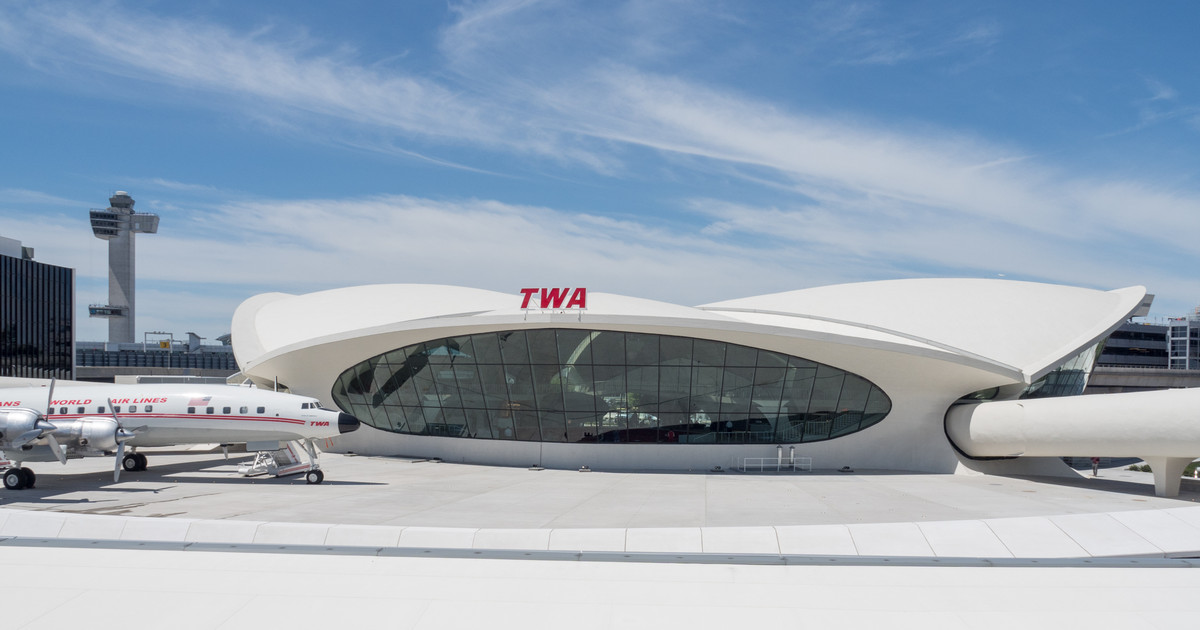
The white roof rises in sweeping curves. Red TWA letters sit above a wall of glass, and a silver aircraft waits outside. The scene belongs to an airport, but its invitation is unusually unhurried: stop, look up, and notice how much thought once went into the moments before a flight.
The TWA Hotel at John F. Kennedy International Airport brings together a restored terminal, a working hotel and an aviation-history collection. You can come for an overnight stay, or visit the public spaces without booking a room. Its appeal is strongest when you give the details a little time.
1962: architecture that seems ready to take flight
Eero Saarinen and Associates designed the TWA Flight Center for what was then Idlewild Airport. It opened in May 1962. The city’s landmark report describes a roof formed from four intersecting reinforced-concrete vaults, separated by narrow skylights. Those curves give a heavy material an extraordinary sense of movement.
Inside, that idea continues through sculptural stairs, a curved balcony, small white tiles and cylindrical flight tubes. There is no need to know architectural terminology to enjoy it: follow the lines with your eyes, then notice how the stairs and bridges guide people through the room. The interior landmark report records these features in detail.
2019: a new life for the Flight Center
The hotel opened in May 2019, as recorded in the Port Authority’s annual report. The historic terminal became its public heart. The 512 guestrooms sit in two newly built wings, so an overnight stay combines contemporary accommodation with the restored building rather than putting every bedroom inside the 1962 terminal.
The restoration reached down to the penny tiles and individually fitted windows. Even the lettering received careful attention: Flight Center Gothic was developed from historic signage drawings held in Saarinen’s archive at Yale. At this scale, a doorway, a direction sign and a roofline become parts of the same visual language.
The Sunken Lounge: red seats beneath a white canopy
The Sunken Lounge supplies the hotel’s most memorable contrast: vivid red seating against pale tile and sweeping white forms. Beyond the glass, Connie’s propellers connect the room to another generation of air travel.
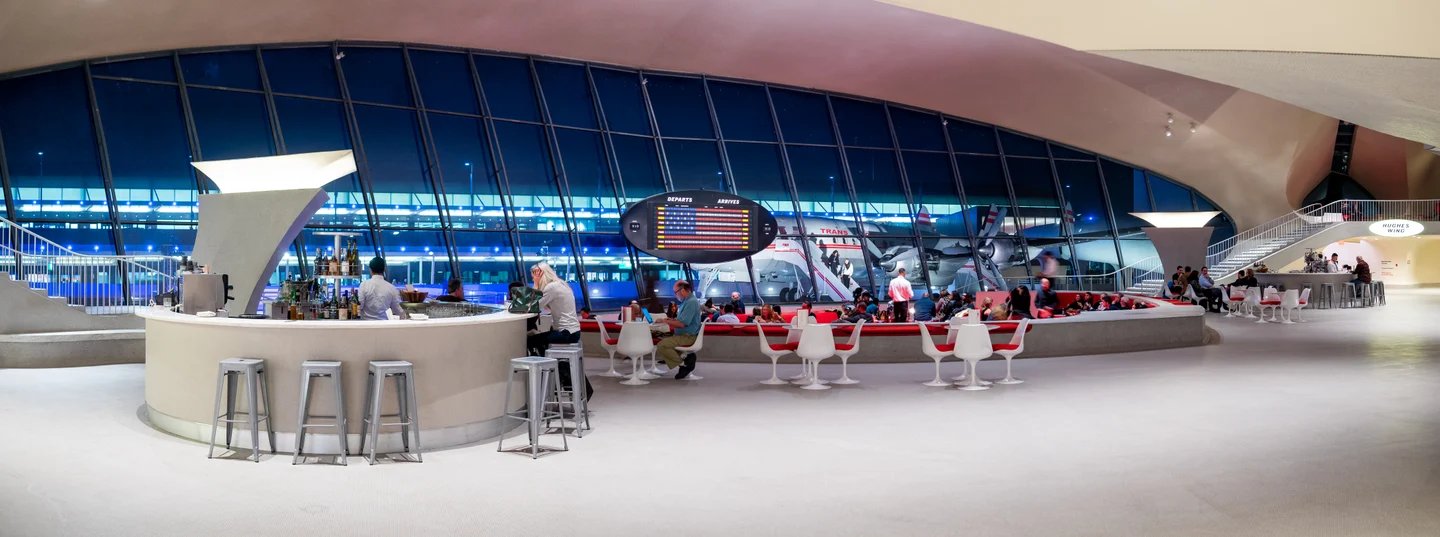
Look for the Solari split-flap board, too. It now displays messages; it is not your flight’s live departure board. The lounge rewards the sort of attention an ordinary connection rarely allows: the curve of a railing, the depth of the conversation pit, the way the windows frame the aircraft outside.
Uniforms, posters and the people behind the airline
The museum exhibits, curated by the New-York Historical Society, add human detail to the architecture. Authentic uniforms, David Klein travel posters and objects donated by former employees show how TWA presented travel and how its staff experienced it. The exhibits are free and open to the public.
Distinguish original objects from interpretation. The recreated offices and 1962 living room are scenes assembled to explain an era, rather than untouched rooms discovered behind a locked door. The uniform story also spans different periods: Stan Herman designed TWA uniforms in the 1970s and later designed clothing for the hotel’s own staff.
Connie: a cocktail lounge with a triple tail
The aircraft outside is a 1958 Lockheed Constellation, the Starliner model known here as Connie. Its long fuselage and three tail fins offer a propeller-era counterpoint to the terminal’s Jet Age curves. Today it houses a cocktail lounge, with a restored cockpit and period-style cabin.
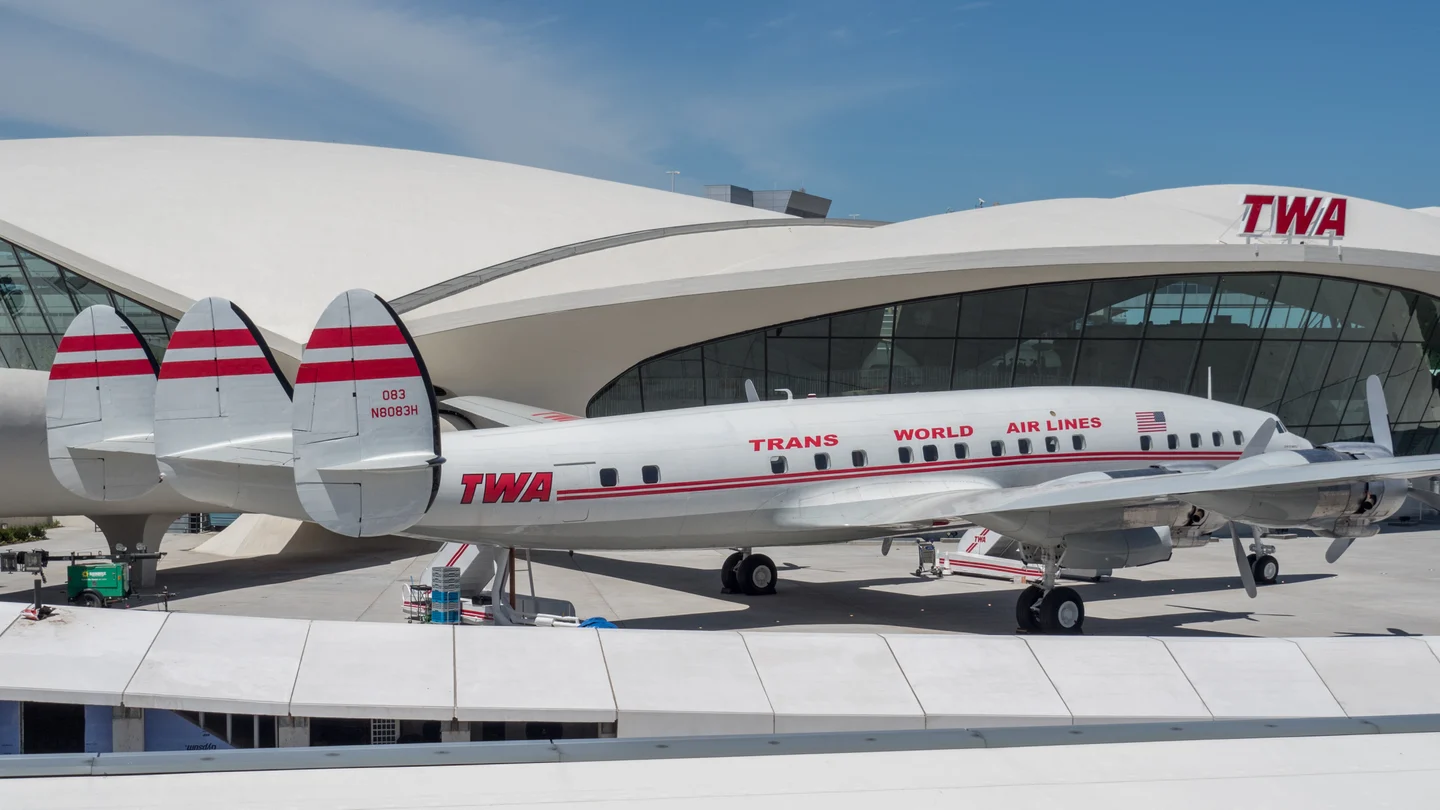
The official Connie page lists current hours and private-event closures. Check it before building a visit around going aboard; seeing the aircraft outside and finding the lounge open are different things.
How to visit, with or without an overnight stay
- From Terminal 5: follow the hotel signs from baggage claim to the TWA elevator and red-carpeted flight tube. From another terminal, use AirTrain to reach Terminal 5 and follow the current hotel directions.
- For a short visit: the lobby, exhibits and restaurants do not require a guestroom booking. Meals, drinks and reservable experiences have their own charges and availability.
- For a room: compare overnight and Daytripper options. The hotel’s FAQ explains the daytime booking conditions. Choose the room’s view deliberately: runway views and views of the historic building offer different pleasures.
- For the rooftop: check the pool’s current access chart. Guest status, season, reservations and private events affect access; an overnight room is not a promise of unrestricted pool use.
The hotel is outside airport security. A visit between flights means allowing for your terminal transfer and security screening again, plus applicable U.S. entry and customs procedures on an international arrival. There is no single safe layover length for every itinerary. Work back from your airline’s boarding deadline before deciding whether a visit fits.
One practical tip: give the visit a simple sequence
Use the SkyStamp packing checklist for the rest of the journey. For another view of the era’s design, continue with Pan Am’s aircraft, globe and uniforms. TWA and Pan Am were distinct airlines; each left its own visual memory of travelling across the world.
Sources and review date
Checked on . Historical photographs are dated in their captions. Hotel access, restaurant hours and booking rules can change; confirm them on the official pages before visiting.
- NYC Landmarks Preservation Commission: TWA Flight Center exterior designation (PDF)
- NYC Landmarks Preservation Commission: Flight Center interior designation (PDF)
- Port Authority: 2019 annual report, TWA Hotel opening (PDF)
- TWA Hotel: restoring the Flight Center and building the guestroom wings
- TWA Hotel: the Sunken Lounge
- TWA Hotel: Flight Center Gothic and the restored signage
- TWA Hotel: public museum exhibits
- TWA Hotel: historical and contemporary uniform design
- TWA Hotel: Connie cocktail lounge and current hours
- TWA Hotel: Terminal 5, AirTrain and driving directions
- TWA Hotel: public access, security, room types and Daytripper stays
- TWA Hotel: current rooftop pool access and reservations