

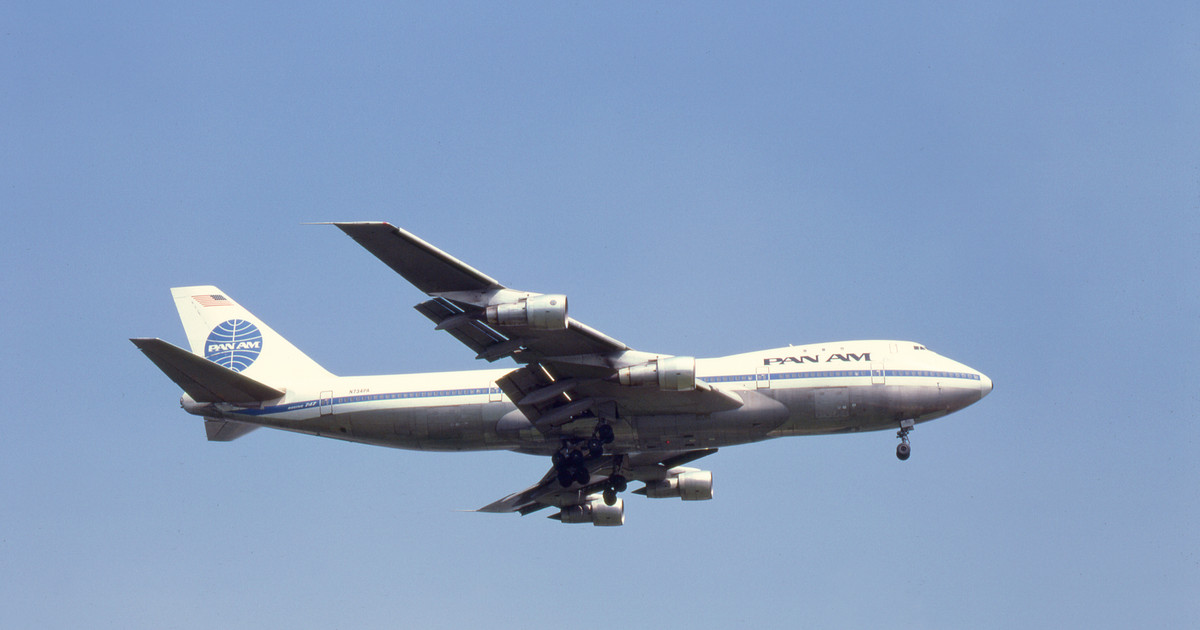
There is an entire travel day hidden in a Pan Am photograph: a blue flight bag, a neatly printed timetable, a long stripe running down a white fuselage. The globe on the tail makes the aircraft seem connected to places far beyond the edge of the frame. Even now, those few details can carry more atmosphere than a page of advertising.
Pan American World Airways helped shape international aviation and the way it looked. Its story spans flying boats and jumbo jets, tailored uniforms and a remarkably durable graphic identity. The objects are beautiful to examine; knowing what they belonged to makes them more interesting still.
Before the jets: mail routes and flying boats
Pan Am was founded in 1927 and began with mail between Key West and Havana. Paying passengers followed on that route in January 1928, according to the University of Miami’s corporate history. The worldwide image grew from those much smaller beginnings.
The Clipper name recalled the fast sailing ships of the nineteenth century. The connection feels especially apt in photographs of the airline’s flying boats: a hull resting on water, propellers above it, the journey beginning at a waterfront. The Martin M-130 China Clipper opened transpacific airmail service in 1935; passenger service followed in 1936. The Smithsonian’s airliner history places that achievement in the development of long-distance flight.
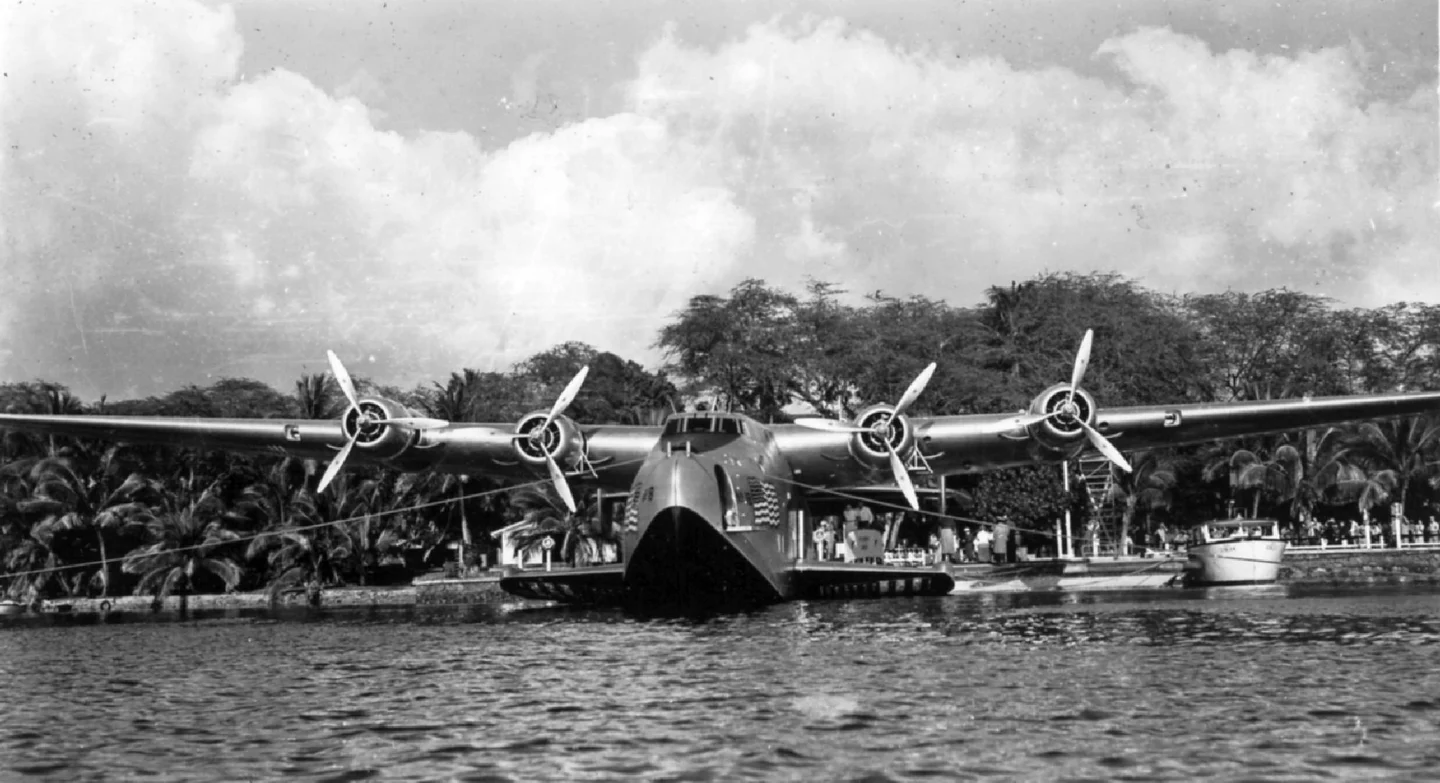
The photograph above shows a Boeing 314, a later Clipper type, rather than the Martin M-130 China Clipper. Look at its broad wing and boat-like hull. It belongs to a stage of aviation when the water itself could be an aircraft’s arrival point. These distinctions matter: “Clipper” was a name used across different aircraft, not one model.
The 707 and 747: a different scale of travel
Pan Am launched Boeing 707 service between New York and Paris on October 26, 1958. Its Boeing 747 passenger service followed in January 1970. The SFO Museum’s poster history and Smithsonian’s Pan Am account trace these milestones.
The 747’s upper-deck hump is an unmistakable silhouette. In the 1982 Heathrow photograph at the top of this article, the aircraft’s size contrasts with the simplicity of its markings: a blue line, a white body and a globe. The jumbo jet also belongs to a broader change. Greater capacity and lower fares helped more people fly, although the sumptuous cabins celebrated in nostalgic imagery were never everyone’s experience.
The blue globe: an airline identity that travelled well
The globe identity arrived in the late 1950s; the Pan Am Historical Foundation’s insignia history shows how the airline’s marks evolved. The globe reproduced here is one form of that enduring identity, not a claim that every line remained unchanged from its introduction.

Its appeal is easy to read. The circle suggests the world; the curved lines suggest a globe without requiring a detailed map. The short name remains prominent. On a tail, a bag or a printed page, the mark makes the same proposition: travel belongs to a connected world. It is shown here for historical identification; this article is independent of the brand.
Uniforms: colour, tailoring and the work behind the image
Uniforms made that identity human. SFO Museum’s Fashion in Flight online gallery documents Don Loper’s 1959 Tunis Blue wool suit, with angular details and a forward-fin hat. Its 1971 example, designed by Frank Smith for Evan-Picone, came in Superjet Blue or Galaxy Gold and paired a modified chesterfield jacket with a flared skirt and bowler hat.
The museum photograph below shows a separate Pan Am ensemble. Notice the hat, the restrained tailoring and the bright blue bag. It is an object worth looking at in its own right, without treating one uniform as the outfit worn throughout the airline’s history.
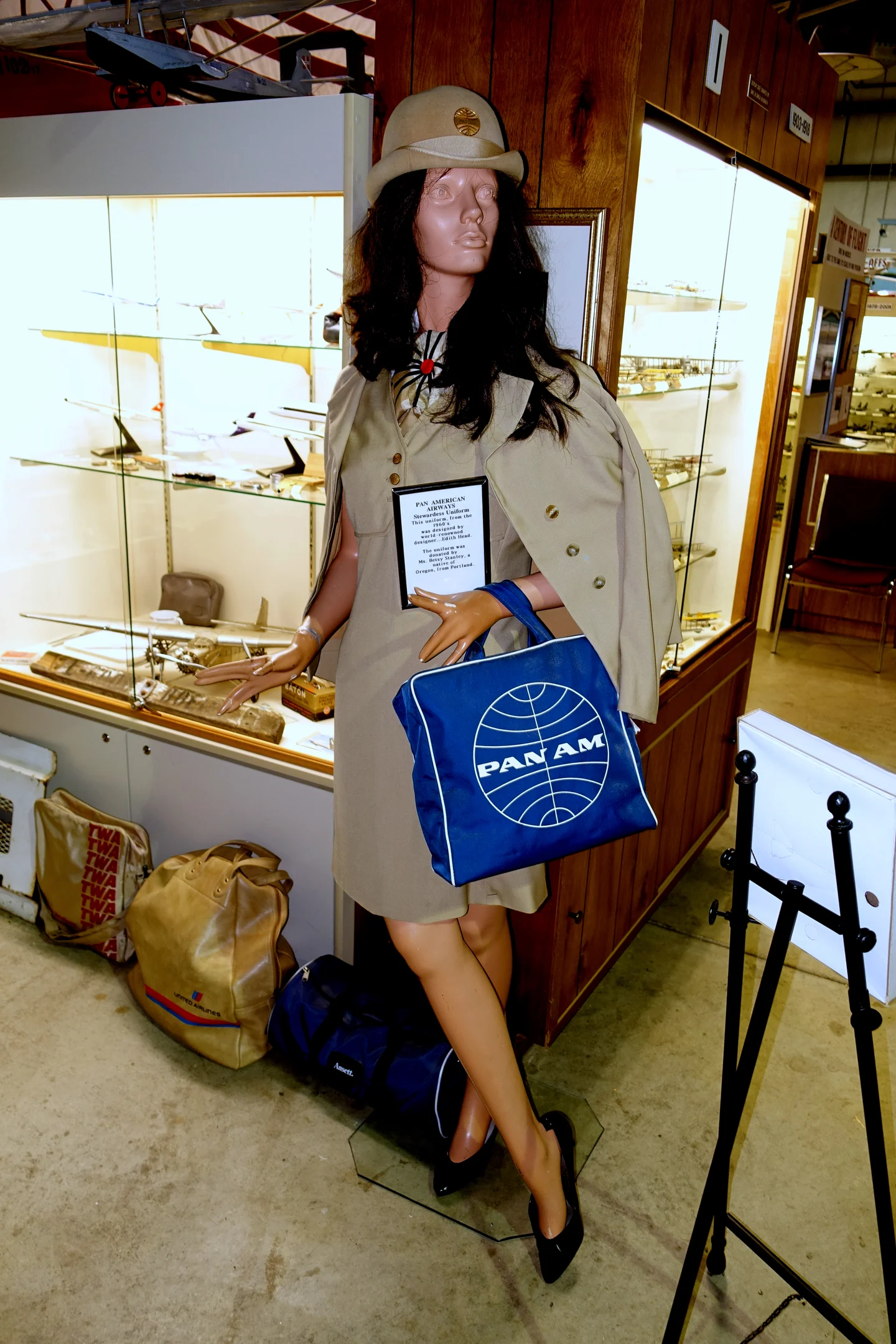
These clothes were workwear as well as publicity. The Smithsonian’s history of flight attendants records the profession’s responsibilities and the industry’s discriminatory restrictions around age, appearance, gender and race. Remembering that labour and the struggle for equal treatment gives the photographs a fuller human context.
1991: the end of the original airline
The original Pan Am stopped flying in December 1991. Its decline involved financial pressures, acquisition costs and the sale of routes and assets; the Lockerbie bombing brought further tragedy. No single event explains the whole story. The University of Miami chronology is a useful place to follow it in more depth.
Later uses of the Pan Am name are a separate story. The photographs here concern the original airline and its legacy, rather than a present-day scheduled airline service.
Where to explore Pan Am history today
- On Long Island: the Pan Am Museum is inside the Cradle of Aviation Museum in Garden City, New York. Check its current hours, exhibitions and admission before travelling. Plan it as a Long Island outing rather than assuming it will fit a short JFK connection.
- From home: explore the University of Miami’s digital collection for company records, photographs and the wider story.
- For design details: browse SFO Museum’s online uniform gallery and historical poster exhibition. Their online availability does not mean those exhibitions are currently on display at the airport.
One practical tip: choose one object to follow
For another airline’s architectural legacy, explore our TWA Hotel guide. TWA and Pan Am were distinct airlines with different stories. If you are making an aviation-history trip, the free SkyStamp packing checklist can take care of the everyday preparation.
Sources and review date
Checked on . This feature concerns the original airline, which operated from 1927 to 1991. Historical image dates are given where known. Check the museum’s official site for current opening hours and admission.
- University of Miami: Pan American corporate history
- University of Miami: Pan American World Airways digital collection
- Smithsonian: Pan American Airways and international commercial aviation
- Smithsonian: evolution of the commercial airliner and China Clipper
- Smithsonian: the Jet Age and changing access to air travel
- SFO Museum: Pan American travel posters, historical exhibition
- SFO Museum: Fashion in Flight online uniform gallery
- Smithsonian: flight attendants, work and equality
- Pan Am Historical Foundation: Luxury on Wings
- Pan Am Historical Foundation: historic insignias
- Pan Am Museum: visiting, exhibitions and current admission information